
Multifunctional Bioactive Biomaterials for Local Therapy and Tissue Regeneration: From passive medical materials to active therapeutic interfaces
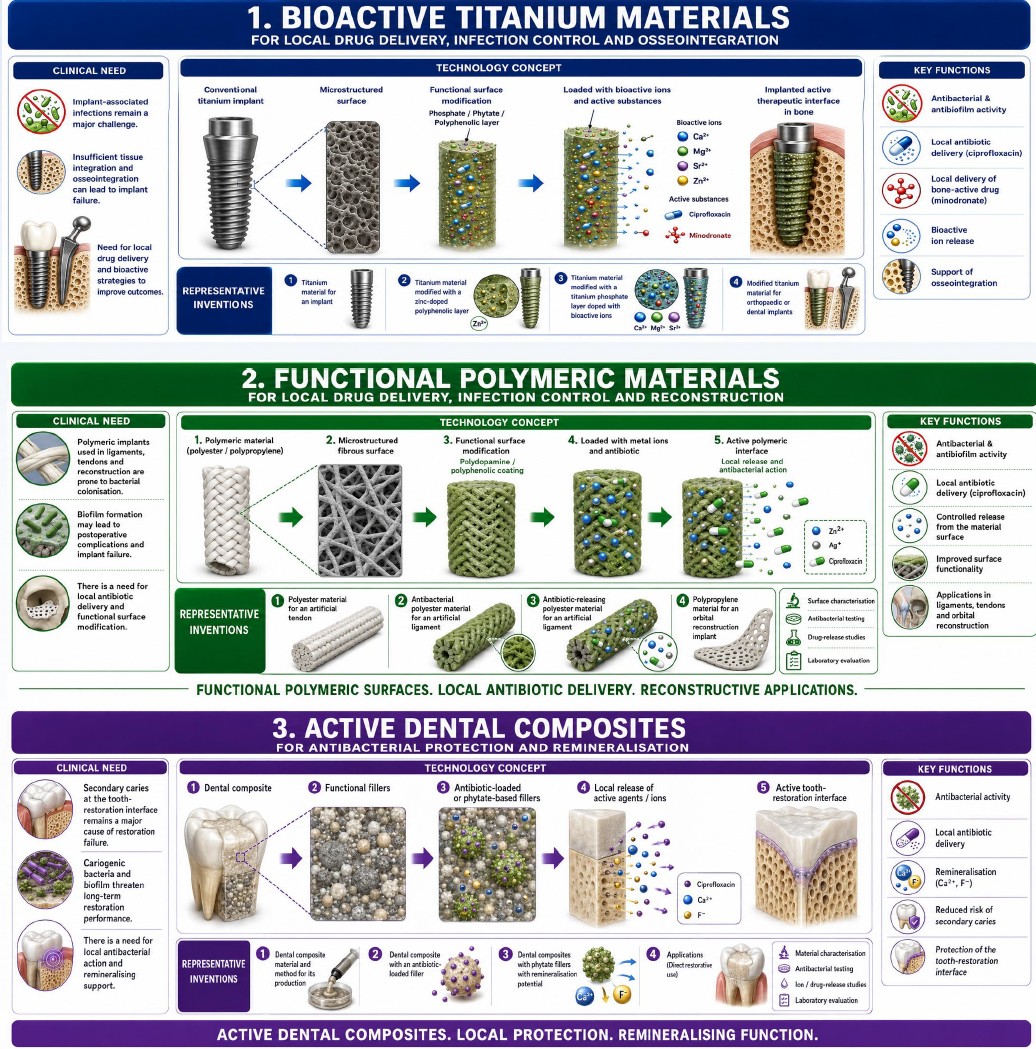
Description: The innovation comprises a family of multifunctional biomaterials developed to transform conventional passive medical materials into active therapeutic systems capable of interacting with their biological environment. The presented portfolio includes inventions for dental, orthopaedic and reconstructive applications. Despite the diversity of the target medical devices, the solutions share a common technological concept: the functional modification of biomaterial surfaces or fillers to introduce additional biological functions, including local drug delivery, antibacterial activity, remineralisation and support of tissue-implant integration.
The developed technologies can be applied to different classes of biomaterials, including titanium, polyester and polypropylene implants, as well as resin-based dental composites. Depending on the clinical application, specially designed bioactive layers or fillers incorporating metal ions, polyphenolic compounds, phosphates, phytates or zeolites are used to bind and locally deliver therapeutic agents or biologically active ions.
In dental applications, the developed solutions include antibacterial composites designed for local antibiotic delivery at the tooth–restoration interface, as well as remineralising composites capable of releasing calcium and fluoride ions in areas particularly susceptible to secondary caries.
For orthopaedic and dental implants, functionalised titanium surfaces combine local therapeutic activity with bioactive components designed to support osseointegration. The same general concept has also been extended to polymer-based artificial tendons and ligaments and to reconstructive implants, where surface modification enables antibacterial activity and the controlled local release of antibiotics.
The key innovation is therefore not a single coating or material composition, but a versatile technological strategy for engineering the interface between an implanted material and the human body. By selecting the biomaterial substrate, functional layer, bioactive ions and therapeutic compound, the technology can be adapted to different clinical needs and applications.
The developed solutions are intended to reduce the risk of implant-associated infections, decrease the need for systemic drug administration, support tissue regeneration and improve the long-term functionality of medical biomaterials.
The concept is supported by a growing portfolio of patents and patent applications and demonstrates a continuous development pathway from functional dental composites to multifunctional metallic and polymeric implants.
Organisation: Poznan University of Technology
Innovator(s): Mariusz Sandomierski, Zuzanna Buchwald, Marcel Jakubowski, Jakub Reczkowski, Aleksandra Domke, Monika Zielińska, Adam Voelkel, Kuba Mularski, Ewa Rosińska, Gabriela Ryś, Martyna Maria Pruszkowska-Barszcz, Kamila Czerniak, Katarzyna Hałas
Category: Medicine, Biotechnology and Medical Devices
Country: Poland