
USE OF SELF-POWERED TENG ELECTRICAL STIMULATION DEVICE BASED ON CHITOSAN THIN FILM AND SILVER NANOPARTICLES FOR ANTIBACTERIAL APPLICATIONS AND PARKINSON’S DISEASE TREATMENT
Description: This project develops a self-powered Triboelectric Nanogenerator (TENG) device that converts mechanical energy into electrical energy, using a chitosan thin film embedded with silver nanoparticles (AgNPs) as the triboelectric positive electrode. The CHI-AgNP (CA1) nanocomposite membrane was synthesized by a casting method and paired with an aluminum/PTFE negative layer to form the power-generating device. The TENG achieved an output voltage of up to 40V and a current density of 2.22 μA/cm², and the resulting electrical stimulation (ES) significantly enhanced antibacterial activity, completely eliminating Escherichia coli after five operating cycles. Beyond energy harvesting and antibacterial applications, the device was explored as a non-invasive electrical stimulation therapy for Parkinson's disease, using the nematode Caenorhabditis elegans as a model organism. Safety experiments confirmed that ES does not significantly affect lifespan, body size, or reproductive capacity. In dopamine-deficient CB1112 mutant worms, ES markedly restored the basic slowing response, dopaminergic neuron fluorescence, and expression of the cat-2 and dat-1 genes involved in dopamine synthesis and reuptake, indicating protective and restorative effects on damaged dopaminergic neurons. Overall, the project demonstrates a biodegradable, self-powered platform with dual antibacterial and neurotherapeutic potential, offering a sustainable, non-invasive alternative to conventional Parkinson's disease treatments such as deep brain stimulation, and laying groundwork for future testing in higher animal models and patient-derived stem cell systems.
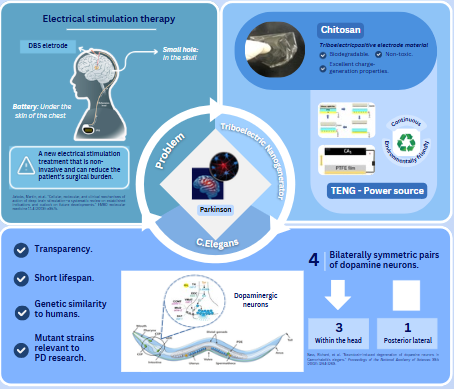
This project designs and fabricates a self-powered Triboelectric Nanogenerator (TENG) device based on the principle of converting mechanical energy into electrical energy. The core active material is a chitosan thin film, a natural, biodegradable, non-toxic biopolymer with strong charge-generation properties, which serves as the positive triboelectric layer. Silver nanoparticles (AgNPs) were incorporated into the chitosan matrix, with chitosan acting as both a reducing and stabilizing agent during nanoparticle synthesis from silver nitrate (AgNO3). The resulting CHI-AgNP (CA1) nanocomposite membrane was fabricated via a simple casting method: chitosan was dissolved in dilute acetic acid, cast into molds, and either oven-dried or UV-cured (for the AgNP-containing formulation) to form thin, flexible films. These films were characterized using IR, UV-Vis, and SEM spectroscopy. The complete TENG device was assembled by pairing the chitosan-AgNP layer with an aluminum electrode backed by a polytetrafluoroethylene (PTFE) negative triboelectric layer, both cut to matching 2×2 cm² dimensions and wired to aluminum electrodes. Electrical output was measured using a digital oscilloscope (Tektronix MDO3052). The device operates through a combination of contact electrification and electrostatic induction: as the chitosan-AgNP film contacts and separates from the PTFE layer, electron transfer generates a measurable current. This design achieved an output voltage of up to 40V and a current density of 2.22 μA/cm², confirming its suitability as a self-powered electrical stimulation (ES) source. The CHI-AgNP membrane also functions as an antibacterial electrode. When used to deliver electrical stimulation, it markedly enhanced antibacterial performance against Escherichia coli, achieving complete bacterial elimination after five TENG operating cycles, demonstrating a promising green sterilization strategy that combines nanomaterial toxicity with electrically driven antimicrobial mechanisms. To evaluate biomedical applications, the device was tested for its potential to treat Parkinson's disease (PD) using Caenorhabditis elegans as a model organism, chosen for its transparency, short lifespan, simple nervous system, genetic tractability, and well-characterized PD-relevant mutant strains. Because deep brain stimulation (DBS), the conventional PD treatment, is invasive and carries surgical risk, this TENG-based ES approach was investigated as a non-invasive alternative. Biocompatibility was assessed first. Wild-type N2 worms stimulated at the L4 larval stage showed no significant difference in lifespan compared to unstimulated controls (13.33 ± 5.46 days versus 12.92 ± 5.68 days). Body length showed a transient reduction on day 1 (94.02 ± 9.06%) but fully recovered by days 3 and 5 (102.04 ± 7.08% and 101.20 ± 7.38%, respectively). Reproductive output was also unaffected, with ES-treated worms laying a comparable number of eggs per day (76.23 ± 34.58) relative to controls (74.2 ± 36.35). Together, these results confirm that TENG-based ES is biologically safe. Therapeutic efficacy was then examined using the basic slowing response assay, which measures dopamine-neuron-mediated behavioral slowing when worms encounter a bacterial food source. In wild-type N2 worms, ES produced no statistically significant behavioral change relative to controls, suggesting the treatment is not simply stimulatory in healthy neurons. However, in CB1112 mutant worms, which lack the cat-2 gene encoding tyrosine hydroxylase and therefore have impaired dopamine synthesis, ES restored the slowing response to 66.87%, compared to only 18.78% in untreated CB1112 controls — a level comparable to wild-type behavior. This indicates that ES selectively benefits worms with dopaminergic deficits rather than enhancing normal neuronal function, positioning the device as a treatment for existing dopaminergic damage rather than a preventive measure. Further mechanistic evidence came from fluorescence imaging using the Pdat-1::GFP BZ555 transgenic strain, in which dopaminergic neurons were damaged using the neurotoxin 6-hydroxydopamine (6-OHDA). Neurotoxin-treated worms without ES showed reduced dat-1 (dopamine transporter) fluorescence, dropping to 55.38 ± 18.82% and 60.15 ± 16.35% of control levels at 24 and 48 hours, respectively. ES treatment significantly improved fluorescence recovery to 74.57 ± 22.58% and 78.75 ± 22.63% at the same time points, indicating that electrical stimulation helps protect and restore damaged dopaminergic neurons. At the molecular level, RT-qPCR analysis showed that ES significantly upregulated expression of the cat-2 gene (dopamine synthesis, tyrosine hydroxylase) by 6.42 ± 1.28-fold and the dat-1 gene (dopamine reuptake transporter) by 1.92 ± 0.4-fold in 6-OHDA-damaged worms relative to untreated controls. These gene expression changes align with the observed behavioral and fluorescence recovery, supporting a neuroprotective mechanism whereby ES enhances dopamine synthesis and reuptake pathways following neurotoxic damage. In conclusion, this project successfully developed a biodegradable, self-powered TENG device using a chitosan-silver nanocomposite membrane that delivers strong electrical output, effective antibacterial action, and safe, therapeutically relevant electrical stimulation. In C. elegans models of Parkinson's disease, the device improved dopaminergic behavior, protected neurons from toxin-induced damage, and upregulated key dopamine-pathway genes, all without harming lifespan, growth, or reproduction. These findings support the TENG device's potential as a sustainable, non-invasive treatment strategy for Parkinson's disease and as an antibacterial platform. Future work will extend testing to mouse models with more complex nervous systems, and, if successful, to neurons differentiated from patient-derived stem cells, alongside further exploration of the device's antibacterial applications under varied conditions.
Organisation: Vinschool Imperia Primary, Secondary and High School
Innovator(s): 1. Do Ngoc Thao Linh; 2. Mai Ngoc Anh; 3. Le Minh Anh; 4. Hoang Thai Son; 5. Tran Dinh Son
Category: Medicine, Biotechnology and Medical Devices
Country: Vietnam