
METHOD FOR PRODUCING A BIODEGRADABLE POLYMER COMPOSITION
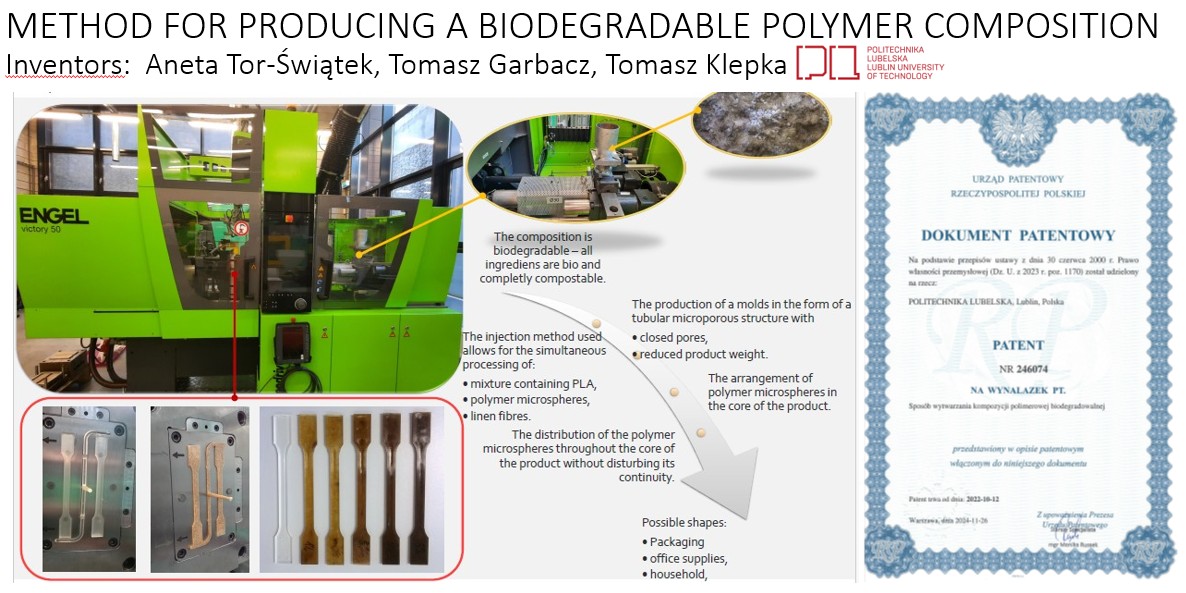
Description: Modern packaging industry requires materials that combine biodegradability with good mechanical performance and production efficiency. In response, a technology has been developed for producing biodegradable polymer composites based on PLA using screw injection molding. The material is modified with polymer microspheres and short flax fibers. During processing, microspheres create a microporous structure that reduces density and material usage, while flax fibers reinforce the composite mechanically. The result is a lightweight material with favorable properties and a controlled internal structure. This solution enables the production of fully biodegradable products from renewable resources, lowers production costs, and does not require major modifications to existing manufacturing lines. The technology is at TRL 4–5 and has been validated in laboratory and near-real conditions.
Modern industry, particularly the packaging sector, faces growing pressure to reduce the negative impact of plastics on the environment. Polymers based on petrochemical raw materials are characterized by slow decomposition and contribute to the growing waste problem. At the same time, the market demands materials that are not only biodegradable but also maintain appropriate mechanical and processing properties, enabling their use in industrial technologies. Therefore, there is a need to develop materials that combine ecology with functionality and production efficiency. A method for producing biodegradable polymer compositions using a screw injection molding process has been developed to address this need. This technology utilizes polylactide (PLA) as the base, biodegradable polymer, which is modified by the addition of two components: polymer microspheres and short flax fibers. The microspheres, as they decompose during processing, create micropores in the structure, resulting in a reduction in density and stiffness. Flax fibers, a natural raw material, mechanically strengthen the material, compensating for the weakness resulting from porosity. The technological process involves the appropriate dosing of ingredients, their plasticization, injection, and cooling under controlled temperature and processing conditions. A key effect is obtaining a material with a microporous structure, in which microspheres are distributed primarily in the core of the product, which allows for optimized performance. This solution stands out from existing technologies with several significant advantages. First, it enables the production of a fully biodegradable material, largely based on renewable raw materials. Second, the use of microspheres increases the efficiency of the injection process and reduces material consumption, translating into lower production costs. Another advantage is the ability to simultaneously achieve favorable mechanical properties and reduced product weight – these characteristics are typically difficult to reconcile. Furthermore, the technology does not require major changes to existing production lines, facilitating its industrial implementation. The controlled structure of the material, including the location of microspheres, is also crucial, allowing for the design of product properties depending on the application. The technology can be classified at TRL 4–5. The solution was verified in laboratory conditions and, to some extent, in a near-real-world environment. The injection molding process was described in detail, and its parameters were selected to ensure repeatable results in the form of finished products. Achieving this TRL level is the result of research into the material composition, technological process, and the properties of the resulting composites. At the same time, the technology requires further optimization and industrial-scale testing to confirm its full implementation suitability and the durability of its parameters in mass production.
Organisation: Lublin University of Technology
Innovator(s): Aneta Tor-Świątek
Category: Nanotechnology, Materials & Engineering
Country: Poland