
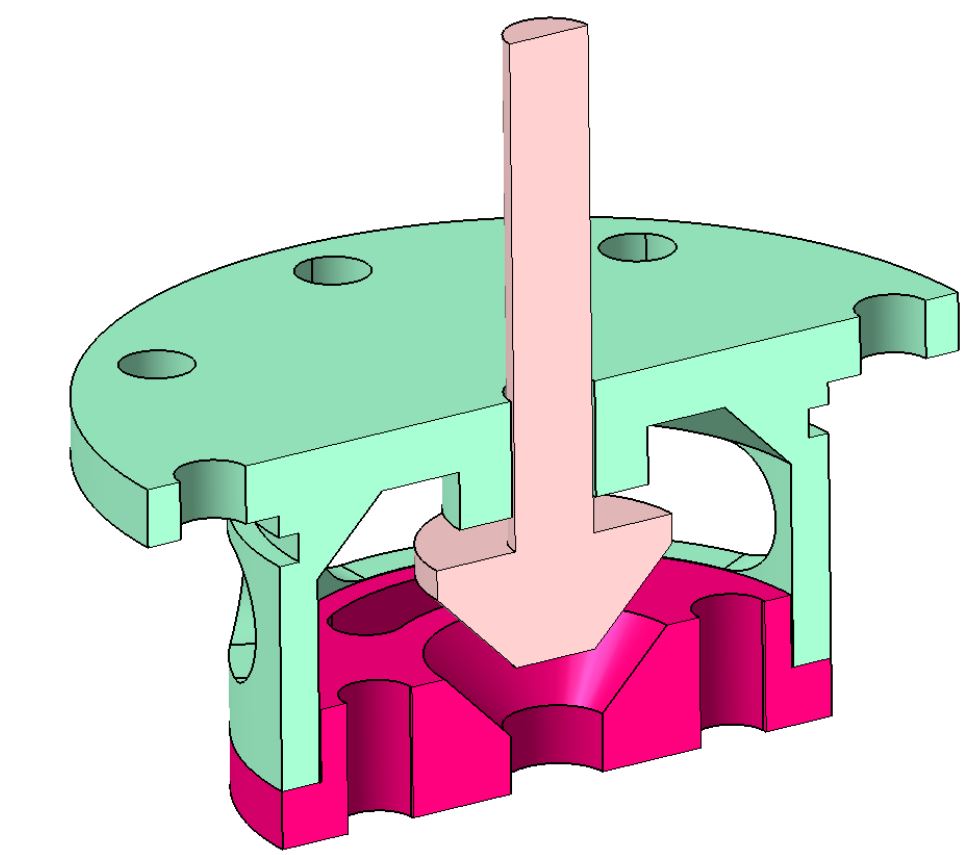
Trigger for crystallisation of latent heat storage, especially used for LPG gas evaporator heater
Description: During cold starts, liquid propane gas (LPG) fuel systems in motor vehicles do not supply gas fuel to the combustion chamber, as the liquid fuel must first be converted to a gaseous state in a reducer-evaporator (RP) connected to the internal combustion engine's cooling system. The subject of the proposed invention enables the initiation of the crystallisation process of supercooled liquid in latent heat reservoirs for heating the evaporator in an LPG (liquefied petroleum gas) automotive system. Thanks to the use of conical surfaces for storing crystals, it is possible to generate high pressure, which prevents the crystals from melting during the heating of the liquid. The use of an electromagnetic actuator and the conical shape of the gap in which the supercooled liquid is located facilitates the crystallisation of the supercooled liquid in contact with the metal in the gap. If the crystallisation process fails to start, the electromagnetic coil allows the pusher to be repeated several times, resulting in the cone striking to create a disturbance that will trigger the initiation. The crystallisation trigger can be directly built into the LPG system control system as an actuator. The LPG reducer-evaporator heating system does not require an additional energy source. Current systems rely on heat supplied from the engine cooling system. It is necessary to drive at least 7 km on petrol/diesel. The parking heating system also consumes fuel to operate. The electric engine heating system consumes electricity from the power grid, and cannot be used when parked outside a garage.
Market Need Automotive liquefied petroleum gas (LPG) systems do not supply gaseous fuel to the combustion chamber during cold starts, as the liquid fuel must first be converted to a gaseous state in the vaporizer (RP) connected to the internal combustion engine’s cooling system. Initially, the internal combustion engine is powered by more expensive liquid fuel (gasoline for spark-ignition engines, diesel for compression-ignition engines). Additionally, fuel consumption is several times higher under these adverse conditions and can reach up to 20 dm³/100 km. The gas system controller activates the system only after the engine has warmed up, opening the solenoid valve on the LPG tank once the temperature exceeds 35°C. This requires driving on gasoline/diesel in urban conditions for up to 7 km in winter conditions. The percentage of liquid fuel consumption in vehicles adapted for LPG operation, used for short trips (commutes, delivery runs, etc.), is high relative to LPG consumption, which negatively impacts the cost-effectiveness and amortization of the costs incurred for installing the LPG system. A low-cost energy source is required to heat the LPG reducer-vaporizer so that the gas supply system can operate during vehicle startup. Ways to meet this need: The following can be used to heat the reducer-evaporator: 1. A heat storage system consisting of a set of tanks (Patent No. EP2273226B1). 2. a parking heater system, e.g., Webasto. 3. an electric vehicle coolant heating system powered by a 220V electrical grid, such as DEFA. 4. a system for recovering and storing thermal energy in a latent heat storage tank To initiate the crystallization of salt, the following may be used: 1. an activation mechanism for mechanically deforming the element that triggers the crystallization process (Patent No. DE102010046243A1). 2. Peltier cells placed at a certain distance from each other, forming a gap to accommodate the phase-change material (patent no. PL/EP3056848B1). 3. A system of interconnected salt tanks before and after crystallization (patent no. DE102017125669A1) 4. An igniter in a multi-module chamber with salt (Patent No. PL432199A1). 5. An electromagnetically triggered spring-loaded actuator forming a conical gap—the subject of our Patent No. B1 243375. Competitive Advantages The LPG reducer-vaporizer heating system does not require an additional power source. Current systems rely on heat supplied by the engine cooling system. A minimum of 7 km must be driven on gasoline or diesel. The parking heater system also consumes fuel to operate. The electric engine preheating system consumes electricity from the power grid, and cannot be used when parked outside a garage. Energy storage in coolant has an energy potential of at least 316 kJ/kg at 90°C and is limited by heat loss through insulation. A system based on salt phase change can store energy at a rate of 264 kJ/kg. At the same time, this energy is recovered during the warm-up and operation of the internal combustion engine. The heat required to heat the liquid in the RP and the RP itself is 187 kJ, and the heat required to vaporize liquefied LPG is 200 kJ. The heat from the crystallization of 3 kg of molten salt (sodium acetate hydrate) will enable the LPG RP to be heated and a distance of 5 km to be covered, after which the engine will reach an operating temperature that allows the RP to function thanks to the vehicle’s cooling system. To initiate crystallization, either pressure within the liquid or a substance that has already crystallized is required. The mechanical components described in the patents do not allow the process to be started automatically. Furthermore, a system equipped with several chambers containing salt in both liquid and solid forms will not reliably initiate the crystallization process. Peltier cells require relatively more energy to initiate the process compared to an electromagnetic element. The subject of the proposed invention enables the initiation of the crystallization process of a supercooled liquid in latent heat reservoirs for heating the evaporator in an automotive LPG system. Thanks to the use of conical surfaces for storing crystals, it is possible to generate high pressure, which prevents the crystals from melting during the heating of the liquid. The use of an electromagnetic actuator and the conical shape of the slot containing the supercooled liquid facilitate the crystallization of the supercooled liquid upon contact with the metal in the slot. In the event that the crystallization process fails to initiate, the use of an electromagnetic coil allows the plunger’s movement to be repeated several times, causing the cone to strike and create a disturbance that triggers the process. The crystallization trigger can be directly integrated as an actuator in the LPG system control system. Technology Readiness Level (TRL) – 6 A prototype or model of the system or technology subsystem has been demonstrated under near-real-world conditions. Thermal calculations have been performed. A design for a demonstrator prototype has been developed, the prototype has been built, and vehicle testing has been conducted under near-real-world conditions.
Organisation: Politechnika Lubelska
Innovator(s): Michał Jan Gęca, Konrad Pietrykowski, Łukasz Grabowski
Category: Energy
Country: Poland